Download Max Payne 2 For Pc Kickass
 Tux the penguin, mascot of Linux[1] | |
| Developer | Community contributors Linus Torvalds |
|---|---|
| Written in | C, associates languages, and others |
| Bone family | Unix-similar |
| Working country | Current |
| Source model | Open source |
| Initial release | September 17, 1991 (1991-09-17) |
| Repository | git |
| Marketing target | Deject computing, embedded devices, mainframe computers, mobile devices, personal computers, servers, supercomputers |
| Available in | Multilingual |
| Platforms | Blastoff, ARC, ARM, C6x, C-Sky, H8/300, Hexagon, IA-64, m68k, Microblaze, MIPS, NDS32, Nios 2, OpenRISC, PA-RISC, PowerPC, RISC-V, s390, SuperH, SPARC, Unicore32, x86, Xtensa |
| Kernel type | Monolithic |
| Userland | GNU[a], BusyBox[b] |
| Default user interface |
|
| License | GPLv2[ix] and others (the name "Linux" is a trademark[c]) |
| Official website | www |
| Manufactures in the serial | |
| Linux kernel Linux distribution | |
Linux ( LEE-nuuks or LIN-uuks)[eleven] is a family of open-source Unix-similar operating systems based on the Linux kernel,[12] an operating organisation kernel first released on September 17, 1991, by Linus Torvalds.[xiii] [14] [15] Linux is typically packaged in a Linux distribution.
Distributions include the Linux kernel and supporting system software and libraries, many of which are provided by the GNU Project. Many Linux distributions use the word "Linux" in their name, merely the Free Software Foundation uses the name "GNU/Linux" to emphasize the importance of GNU software, causing some controversy.[16] [17]
Popular Linux distributions[18] [nineteen] [20] include Debian, Fedora Linux, and Ubuntu. Commercial distributions include Red Chapeau Enterprise Linux and SUSE Linux Enterprise. Desktop Linux distributions include a windowing organization such as X11 or Wayland, and a desktop environs such as GNOME or KDE Plasma. Distributions intended for servers may omit graphics altogether, or include a solution stack such as LAMP. Because Linux is freely redistributable, anyone may create a distribution for any purpose.[21]
Linux was originally developed for personal computers based on the Intel x86 architecture, but has since been ported to more than platforms than any other operating organization.[22] Because of the dominance of the Linux-based Android on smartphones, Linux also has the largest installed base of all general-purpose operating systems.[23] [24] [25] [26] Although Linux is used past just around 2.iii percent of desktop computers,[27] [28] the Chromebook, which runs the Linux kernel-based Chrome Bone, dominates the US K–12 education market and represents almost 20 percent of sub-$300 notebook sales in the US.[29] Linux is the leading operating system on servers (over 96.4% of the superlative 1 million web servers' operating systems are Linux),[30] leads other big atomic number 26 systems such equally mainframe computers, and is the merely Bone used on TOP500 supercomputers (since November 2017, having gradually eliminated all competitors).[31] [32] [33]
Linux as well runs on embedded systems, i.east. devices whose operating system is typically congenital into the firmware and is highly tailored to the system. This includes routers, automation controls, smart domicile technology, televisions (Samsung and LG Smart TVs apply Tizen and WebOS, respectively),[34] [35] [36] automobiles (for example, Tesla, Audi, Mercedes-Benz, Hyundai, and Toyota all rely on Linux),[37] digital video recorders, video game consoles, and smartwatches.[38] The Falcon 9's and the Dragon 2's avionics use a customized version of Linux.[39]
Linux is one of the nearly prominent examples of gratuitous and open up-source software collaboration. The source code may be used, modified and distributed commercially or non-commercially by anyone nether the terms of its respective licenses, such as the GNU General Public License.[21]
History [edit]
Precursors [edit]
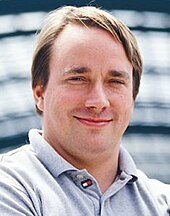
The Unix operating organisation was conceived and implemented in 1969, at AT&T's Bell Labs, in the United States by Ken Thompson, Dennis Ritchie, Douglas McIlroy, and Joe Ossanna.[twoscore] Outset released in 1971, Unix was written entirely in assembly linguistic communication, every bit was mutual practice at the fourth dimension. In 1973 in a primal, pioneering approach, it was rewritten in the C programming language by Dennis Ritchie (with the exception of some hardware and I/O routines). The availability of a high-level language implementation of Unix made its porting to unlike computer platforms easier.[41]
Due to an earlier antitrust example forbidding it from entering the computer business, AT&T was required to license the operating organization's source lawmaking to anyone who asked. As a result, Unix grew apace and became widely adopted by bookish institutions and businesses. In 1984, AT&T divested itself of Bell Labs; freed of the legal obligation requiring complimentary licensing, Bong Labs began selling Unix as a proprietary product, where users were not legally allowed to change Unix.
The GNU Projection, started in 1983 by Richard Stallman, had the goal of creating a "complete Unix-uniform software system" composed entirely of free software. Work began in 1984.[42] Afterward, in 1985, Stallman started the Costless Software Foundation and wrote the GNU General Public License (GNU GPL) in 1989. Past the early 1990s, many of the programs required in an operating system (such as libraries, compilers, text editors, a command-line vanquish, and a windowing arrangement) were completed, although depression-level elements such as device drivers, daemons, and the kernel, called GNU Hurd, were stalled and incomplete.[43]
MINIX was created past Andrew S. Tanenbaum, a information science professor, and released in 1987 as a minimal Unix-like operating system targeted at students and others who wanted to acquire operating system principles. Although the complete source code of MINIX was freely available, the licensing terms prevented it from beingness complimentary software until the licensing changed in Apr 2000.[44]
Although non released until 1992, due to legal complications, development of 386BSD, from which NetBSD, OpenBSD and FreeBSD descended, predated that of Linux.
Linus Torvalds has stated on divide occasions that if the GNU kernel or 386BSD had been available at the time (1991), he probably would not accept created Linux.[45] [46]
Cosmos [edit]
In 1991, while attending the University of Helsinki, Torvalds became curious nearly operating systems.[47] Frustrated past the licensing of MINIX, which at the time limited it to educational use only,[44] he began to piece of work on his own operating system kernel, which eventually became the Linux kernel.
Torvalds began the evolution of the Linux kernel on MINIX and applications written for MINIX were too used on Linux. Afterward, Linux matured and further Linux kernel development took place on Linux systems.[48] GNU applications also replaced all MINIX components, because it was advantageous to employ the freely available code from the GNU Projection with the fledgling operating system; code licensed under the GNU GPL tin exist reused in other computer programs as long as they besides are released under the same or a compatible license. Torvalds initiated a switch from his original license, which prohibited commercial redistribution, to the GNU GPL.[49] Developers worked to integrate GNU components with the Linux kernel, making a fully functional and free operating system.[fifty]
Naming [edit]

v.25-inch floppy disks holding a very early on version of Linux
Linus Torvalds had wanted to telephone call his invention "Freax", a portmanteau of "free", "freak", and "x" (equally an allusion to Unix). During the start of his work on the arrangement, some of the projection's makefiles included the proper noun "Freax" for about half a twelvemonth. Torvalds had already considered the name "Linux", but initially dismissed it as too egotistical.[51]
To facilitate development, the files were uploaded to the FTP server (ftp.funet.fi) of FUNET in September 1991. Ari Lemmke, Torvalds' coworker at the Helsinki University of Technology (HUT), who was i of the volunteer administrators for the FTP server at the time, did not think that "Freax" was a good name, so he named the project "Linux" on the server without consulting Torvalds.[51] Later, however, Torvalds consented to "Linux".
According to a newsgroup post by Torvalds,[11] the discussion "Linux" should be pronounced ( LIN-uuks) with a brusk 'i' as in 'impress' and 'u' as in 'put'. To further demonstrate how the word "Linux" should be pronounced, he included an audio guide (  listen(aid·info) ) with the kernel source lawmaking.[52] All the same, in this recording, he pronounces 'Linux' ( LEEN-uuks with a short but close unrounded front vowel.
Commercial and popular uptake [edit]

Ubuntu, a popular Linux distribution

Adoption of Linux in production environments, rather than beingness used but by hobbyists, started to have off kickoff in the mid-1990s in the supercomputing community, where organizations such as NASA started to supplant their increasingly expensive machines with clusters of inexpensive commodity computers running Linux. Commercial use began when Dell and IBM, followed past Hewlett-Packard, started offering Linux support to escape Microsoft'south monopoly in the desktop operating organization market.[53]
Today, Linux systems are used throughout computing, from embedded systems to virtually all supercomputers,[33] [54] and have secured a place in server installations such as the popular LAMP application stack. Use of Linux distributions in home and enterprise desktops has been growing.[55] [56] [57] [58] [59] [60] [61] Linux distributions accept also become pop in the netbook market, with many devices shipping with customized Linux distributions installed, and Google releasing their ain Chrome OS designed for netbooks.
Linux's greatest success in the consumer market is perhaps the mobile device marketplace, with Android existence the dominant operating system on smartphones and very popular on tablets and, more recently, on wearables. Linux gaming is besides on the rise with Valve showing its support for Linux and rolling out SteamOS, its own gaming-oriented Linux distribution. Linux distributions accept also gained popularity with diverse local and national governments, such as the federal government of Brazil.[62]
Current evolution [edit]

Greg Kroah-Hartman is the lead maintainer for the Linux kernel and guides its development.[63] William John Sullivan is the executive director of the Gratuitous Software Foundation,[64] which in plow supports the GNU components.[65] Finally, individuals and corporations develop tertiary-party not-GNU components. These third-party components incorporate a vast torso of work and may include both kernel modules and user applications and libraries.
Linux vendors and communities combine and distribute the kernel, GNU components, and non-GNU components, with boosted package management software in the form of Linux distributions.
Design [edit]
Many open up source developers agree that the Linux kernel was non designed but rather evolved through natural option. Torvalds considers that although the design of Unix served as a scaffolding, "Linux grew with a lot of mutations – and considering the mutations were less than random, they were faster and more directed than alpha-particles in DNA."[66] Eric S. Raymond considers Linux's revolutionary aspects to exist social, non technical: before Linux, complex software was designed carefully past pocket-sized groups, but "Linux evolved in a completely different fashion. From nearly the offset, it was rather casually hacked on past huge numbers of volunteers analogous merely through the Internet. Quality was maintained non by rigid standards or autocracy but past the naively simple strategy of releasing every week and getting feedback from hundreds of users within days, creating a sort of rapid Darwinian option on the mutations introduced by developers."[67] Bryan Cantrill, an engineer of a competing OS, agrees that "Linux wasn't designed, it evolved", but considers this to be a limitation, proposing that some features, especially those related to security,[68] cannot exist evolved into, "this is non a biological arrangement at the terminate of the day, it's a software system."[69] A Linux-based system is a modular Unix-similar operating arrangement, deriving much of its basic design from principles established in Unix during the 1970s and 1980s. Such a arrangement uses a monolithic kernel, the Linux kernel, which handles process control, networking, access to the peripherals, and file systems. Device drivers are either integrated directly with the kernel, or added as modules that are loaded while the organisation is running.[70]
The GNU userland is a primal part of most systems based on the Linux kernel, with Android being the notable exception. The Project's implementation of the C library works as a wrapper for the system calls of the Linux kernel necessary to the kernel-userspace interface, the toolchain is a broad drove of programming tools vital to Linux development (including the compilers used to build the Linux kernel itself), and the coreutils implement many bones Unix tools. The projection also develops Bash, a popular CLI shell. The graphical user interface (or GUI) used by most Linux systems is built on summit of an implementation of the X Window System.[71] More than recently, the Linux customs seeks to advance to Wayland every bit the new display server protocol in identify of X11. Many other open up-source software projects contribute to Linux systems.
| User mode | User applications | bash, LibreOffice, GIMP, Blender, 0 A.D., Mozilla Firefox, ... | ||||
|---|---|---|---|---|---|---|
| System components | init daemon: OpenRC, runit, systemd... | Organisation daemons: polkitd, smbd, sshd, udevd... | Window manager: X11, Wayland, SurfaceFlinger (Android) | Graphics: Mesa, AMD Catalyst, ... | Other libraries: GTK, Qt, EFL, SDL, SFML, FLTK, GNUstep, ... | |
| C standard library | fopen, execv, malloc, memcpy, localtime, pthread_create... (upward to 2000 subroutines)glibc aims to exist fast, musl and uClibc target embedded systems, bionic written for Android, etc. All aim to exist POSIX/SUS-compatible. | |||||
| Kernel mode | Linux kernel | stat, splice, dup, read, open, ioctl, write, mmap, shut, exit, etc. (about 380 system calls)The Linux kernel System Phone call Interface (SCI), aims to be POSIX/SUS-compatible[72] | ||||
| Process scheduling subsystem | IPC subsystem | Memory management subsystem | Virtual files subsystem | Network subsystem | ||
| Other components: ALSA, DRI, evdev, klibc, LVM, device mapper, Linux Network Scheduler, Netfilter Linux Security Modules: SELinux, TOMOYO, AppArmor, Smack | ||||||
| Hardware (CPU, master retentiveness, data storage devices, etc.) | ||||||
Installed components of a Linux system include the following:[71] [73]
- A bootloader, for case GNU Chow, LILO, SYSLINUX, or Gummiboot. This is a program that loads the Linux kernel into the computer's main memory, by being executed by the computer when information technology is turned on and subsequently the firmware initialization is performed.
- An init program, such as the traditional sysvinit and the newer systemd, OpenRC and Upstart. This is the first procedure launched by the Linux kernel, and is at the root of the process tree: in other terms, all processes are launched through init. Information technology starts processes such as system services and login prompts (whether graphical or in final mode).
- Software libraries, which contain code that can exist used by running processes. On Linux systems using ELF-format executable files, the dynamic linker that manages the use of dynamic libraries is known as ld-linux.and so. If the system is fix upwardly for the user to compile software themselves, header files will likewise be included to describe the interface of installed libraries. Also the most usually used software library on Linux systems, the GNU C Library (glibc), there are numerous other libraries, such as SDL and Mesa.
- C standard library is the library needed to run C programs on a computer arrangement, with the GNU C Library being the standard. For embedded systems, alternatives such equally the musl, EGLIBC (a glibc fork once used by Debian) and uClibc (which was designed for uClinux) have been developed, although the last two are no longer maintained. Android uses its own C library, Bionic.
- Bones Unix commands, with GNU coreutils being the standard implementation. Alternatives exist for embedded systems, such every bit the copyleft BusyBox, and the BSD-licensed Toybox.
- Widget toolkits are the libraries used to build graphical user interfaces (GUIs) for software applications. Numerous widget toolkits are available, including GTK and Ataxia developed past the GNOME projection, Qt adult by the Qt Project and led by The Qt Company, and Enlightenment Foundation Libraries (EFL) developed primarily by the Enlightenment team.
- A package management system, such as dpkg and RPM. Alternatively packages can be compiled from binary or source tarballs.
- User interface programs such as command shells or windowing environments.
User interface [edit]
The user interface, too known every bit the vanquish, is either a control-line interface (CLI), a graphical user interface (GUI), or controls fastened to the associated hardware, which is common for embedded systems. For desktop systems, the default user interface is usually graphical, although the CLI is commonly bachelor through last emulator windows or on a separate virtual console.
CLI shells are text-based user interfaces, which use text for both input and output. The dominant shell used in Linux is the Bourne-Again Shell (bash), originally adult for the GNU project. Most low-level Linux components, including diverse parts of the userland, use the CLI exclusively. The CLI is particularly suited for automation of repetitive or delayed tasks and provides very uncomplicated inter-process communication.
On desktop systems, the most pop user interfaces are the GUI shells, packaged together with extensive desktop environments, such as KDE Plasma, GNOME, MATE, Cinnamon, LXDE, Pantheon and Xfce, though a variety of additional user interfaces exist. Most popular user interfaces are based on the Ten Window System, often but called "X". Information technology provides network transparency and permits a graphical application running on 1 system to be displayed on some other where a user may collaborate with the application; however, certain extensions of the X Window Organisation are not capable of working over the network.[74] Several X brandish servers exist, with the reference implementation, Ten.Org Server, being the about pop.
Server distributions might provide a command-line interface for developers and administrators, merely provide a custom interface towards end-users, designed for the apply-instance of the system. This custom interface is accessed through a client that resides on some other system, not necessarily Linux based.
Several types of window managers be for X11, including tiling, dynamic, stacking and compositing. Window managers provide ways to control the placement and appearance of individual application windows, and interact with the X Window Arrangement. Simpler 10 window managers such as dwm, ratpoison, i3wm, or herbstluftwm provide a minimalist functionality, while more elaborate window managers such as FVWM, Enlightenment or Window Maker provide more features such equally a built-in taskbar and themes, but are still lightweight when compared to desktop environments. Desktop environments include window managers as part of their standard installations, such equally Complain (GNOME), KWin (KDE) or Xfwm (xfce), although users may cull to use a different window manager if preferred.
Wayland is a brandish server protocol intended every bit a replacement for the X11 protocol; as of 2014[update], it has not received wider adoption. Unlike X11, Wayland does non need an external window manager and compositing manager. Therefore, a Wayland compositor takes the role of the brandish server, window manager and compositing manager. Weston is the reference implementation of Wayland, while GNOME's Mutter and KDE's KWin are being ported to Wayland as standalone display servers. Enlightenment has already been successfully ported since version 19.[75]
Video input infrastructure [edit]
Linux currently has 2 modernistic kernel-userspace APIs for treatment video input devices: V4L2 API for video streams and radio, and DVB API for digital Goggle box reception.[76]
Due to the complexity and diverseness of different devices, and due to the large number of formats and standards handled past those APIs, this infrastructure needs to evolve to ameliorate fit other devices. Likewise, a good userspace device library is the central of the success for having userspace applications to be able to piece of work with all formats supported by those devices.[77] [78]
Evolution [edit]
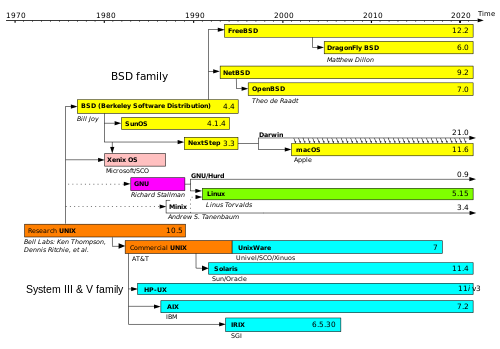
Simplified history of Unix-like operating systems. Linux shares similar architecture and concepts (as part of the POSIX standard) only does not share non-costless source code with the original Unix or MINIX.
The principal difference between Linux and many other popular contemporary operating systems is that the Linux kernel and other components are free and open-source software. Linux is not the only such operating arrangement, although it is past far the virtually widely used.[79] Some free and open-source software licenses are based on the principle of copyleft, a kind of reciprocity: any piece of work derived from a copyleft piece of software must also be copyleft itself. The near common gratis software license, the GNU Full general Public License (GPL), is a course of copyleft, and is used for the Linux kernel and many of the components from the GNU Project.[80]
Linux-based distributions are intended by developers for interoperability with other operating systems and established calculating standards. Linux systems adhere to POSIX,[81] SUS,[82] LSB, ISO, and ANSI standards where possible, although to date only one Linux distribution has been POSIX.one certified, Linux-FT.[83] [84]
Complimentary software projects, although developed through collaboration, are often produced independently of each other. The fact that the software licenses explicitly let redistribution, however, provides a ground for larger-scale projects that collect the software produced by stand-lone projects and brand it bachelor all at once in the form of a Linux distribution.
Many Linux distributions manage a remote collection of system software and awarding software packages bachelor for download and installation through a network connexion. This allows users to adapt the operating system to their specific needs. Distributions are maintained past individuals, loose-knit teams, volunteer organizations, and commercial entities. A distribution is responsible for the default configuration of the installed Linux kernel, general system security, and more generally integration of the different software packages into a coherent whole. Distributions typically use a package manager such as apt, yum, zypper, pacman or portage to install, remove, and update all of a system's software from i cardinal location.[85]
[edit]
A distribution is largely driven past its developer and user communities. Some vendors develop and fund their distributions on a volunteer footing, Debian being a well-known case. Others maintain a community version of their commercial distributions, as Red Chapeau does with Fedora, and SUSE does with openSUSE.[86] [87]
In many cities and regions, local associations known as Linux User Groups (LUGs) seek to promote their preferred distribution and past extension free software. They agree meetings and provide gratis demonstrations, training, technical back up, and operating arrangement installation to new users. Many Internet communities too provide support to Linux users and developers. Most distributions and gratis software / open-source projects have IRC chatrooms or newsgroups. Online forums are another means for support, with notable examples being LinuxQuestions.org and the diverse distribution specific support and community forums, such every bit ones for Ubuntu, Fedora, and Gentoo. Linux distributions host mailing lists; commonly at that place will exist a specific topic such as usage or development for a given list.
There are several technology websites with a Linux focus. Impress magazines on Linux often packet comprehend disks that carry software or even consummate Linux distributions.[88] [89]
Although Linux distributions are generally bachelor without charge, several big corporations sell, support, and contribute to the development of the components of the system and of free software. An analysis of the Linux kernel in 2017 showed that well over 85% of the lawmaking developed by programmers who are beingness paid for their work, leaving about eight.ii% to unpaid developers and four.1% unclassified.[90] Some of the major corporations that provide contributions include Intel, Samsung, Google, AMD, Oracle and Facebook.[91] A number of corporations, notably Red Chapeau, Canonical and SUSE, have built a significant business around Linux distributions.
The gratuitous software licenses, on which the various software packages of a distribution built on the Linux kernel are based, explicitly suit and encourage commercialization; the relationship between a Linux distribution equally a whole and private vendors may be seen as symbiotic. 1 common business model of commercial suppliers is charging for support, especially for business users. A number of companies also offer a specialized business version of their distribution, which adds proprietary support packages and tools to administer college numbers of installations or to simplify administrative tasks.
Another business model is to give away the software to sell hardware. This used to be the norm in the computer industry, with operating systems such every bit CP/M, Apple tree DOS and versions of Mac Os prior to 7.6 freely copyable (merely not modifiable). Every bit computer hardware standardized throughout the 1980s, it became more than difficult for hardware manufacturers to turn a profit from this tactic, as the Bone would run on whatever manufacturer's calculator that shared the same architecture.
Programming on Linux [edit]
Most programming languages support Linux either directly or through third-political party community based ports.[92] The original development tools used for edifice both Linux applications and operating system programs are found within the GNU toolchain, which includes the GNU Compiler Collection (GCC) and the GNU Build System. Among others, GCC provides compilers for Ada, C, C++, Get and Fortran. Many programming languages have a cross-platform reference implementation that supports Linux, for instance PHP, Perl, Ruby, Python, Java, Go, Rust and Haskell. Kickoff released in 2003, the LLVM projection provides an alternative cross-platform open-source compiler for many languages. Proprietary compilers for Linux include the Intel C++ Compiler, Sun Studio, and IBM XL C/C++ Compiler. BASIC in the class of Visual Basic is supported in such forms every bit Gambas, FreeBASIC, and XBasic, and in terms of terminal programming or QuickBASIC or Turbo Basic programming in the form of QB64.
A common feature of Unix-like systems, Linux includes traditional specific-purpose programming languages targeted at scripting, text processing and system configuration and management in full general. Linux distributions back up beat out scripts, awk, sed and make. Many programs as well have an embedded programming language to support configuring or programming themselves. For instance, regular expressions are supported in programs like grep and locate, the traditional Unix MTA Sendmail contains its own Turing complete scripting system, and the advanced text editor GNU Emacs is built around a general purpose Lisp interpreter.
Most distributions as well include support for PHP, Perl, Cherry-red, Python and other dynamic languages. While not as common, Linux too supports C# (via Mono), Vala, and Scheme. Guile Scheme acts as an extension linguistic communication targeting the GNU arrangement utilities, seeking to make the conventionally small, static, compiled C programs of Unix blueprint rapidly and dynamically extensible via an elegant, functional high-level scripting system; many GNU programs can be compiled with optional Guile bindings to this terminate. A number of Java Virtual Machines and development kits run on Linux, including the original Sun Microsystems JVM (HotSpot), and IBM's J2SE RE, as well as many open-source projects like Kaffe and JikesRVM.
GNOME and KDE are popular desktop environments and provide a framework for developing applications. These projects are based on the GTK and Qt widget toolkits, respectively, which can also be used independently of the larger framework. Both support a wide variety of languages. There are a number of Integrated evolution environments available including Anjuta, Code::Blocks, CodeLite, Eclipse, Geany, ActiveState Komodo, KDevelop, Lazarus, MonoDevelop, NetBeans, and Qt Creator, while the long-established editors Vim, nano and Emacs remain popular.[93]
Hardware support [edit]

Linux is ubiquitously found on various types of hardware.
The Linux kernel is a widely ported operating arrangement kernel, bachelor for devices ranging from mobile phones to supercomputers; it runs on a highly diverse range of computer architectures, including the manus-held ARM-based iPAQ and the IBM mainframes Organisation z9 or System z10.[94] Specialized distributions and kernel forks be for less mainstream architectures; for example, the ELKS kernel fork can run on Intel 8086 or Intel 80286 16-flake microprocessors, while the µClinux kernel fork may run on systems without a memory management unit. The kernel also runs on architectures that were only ever intended to employ a manufacturer-created operating system, such every bit Macintosh computers[95] [96] (with both PowerPC and Intel processors), PDAs, video game consoles, portable music players, and mobile phones.
There are several industry associations and hardware conferences devoted to maintaining and improving support for various hardware nether Linux, such every bit FreedomHEC. Over time, support for different hardware has improved in Linux, resulting in whatsoever off-the-shelf purchase having a "good chance" of beingness compatible.[97]
In 2014, a new initiative was launched to automatically collect a database of all tested hardware configurations.[98]
Uses [edit]
[edit]
Many quantitative studies of free/open-source software focus on topics including market share and reliability, with numerous studies specifically examining Linux.[99] The Linux market place is growing, and the Linux operating organization market size is expected to come across a growth of 19.2% by 2027, reaching $15.64 billion, compared to $three.89 billion in 2019.[100] Analysts and proponents attribute the relative success of Linux to its security, reliability, low cost, and freedom from vendor lock-in.[101] [102]
- Desktops and laptops
- Co-ordinate to web server statistics (that is, based on the numbers recorded from visits to websites by client devices), as of November 2018[update], the estimated market share of Linux on desktop computers is effectually 2.i%. In comparing, Microsoft Windows has a market place share of effectually 87%, while macOS covers effectually nine.vii%.[27]
- Spider web servers
- W3Cook publishes stats that use the height 1,000,000 Alexa domains,[103] which as of May 2015[update] estimate that 96.55% of spider web servers run Linux, 1.73% run Windows, and 1.72% run FreeBSD.[104]
- W3Techs publishes stats that utilize the top 10,000,000 Alexa domains and the acme one,000,000 Tranco domains, updated monthly[105] and equally of November 2020 approximate that Linux is used by 39% of the spider web servers, versus 21.9% existence used past Microsoft Windows.[106] 40.i% used other types of Unix.[107]
- IDC's Q1 2007 written report indicated that Linux held 12.7% of the overall server market at that fourth dimension;[108] this guess was based on the number of Linux servers sold by various companies, and did not include server hardware purchased separately that had Linux installed on information technology later.
- Mobile devices
- Android, which is based on the Linux kernel, has become the dominant operating organization for smartphones. During the second quarter of 2013, 79.3% of smartphones sold worldwide used Android.[109] [ needs update ] Android is also a pop operating arrangement for tablets, being responsible for more than threescore% of tablet sales as of 2013.[110] Co-ordinate to web server statistics, as of Oct 2021[update] Android has a marketplace share of about 71%, with iOS belongings 28%, and the remaining 1% attributed to various niche platforms.[111]
- Film production
- For years Linux has been the platform of choice in the film manufacture. The offset major moving picture produced on Linux servers was 1997'due south Titanic.[112] [113] Since then major studios including DreamWorks Animation, Pixar, Weta Digital, and Industrial Light & Magic accept migrated to Linux.[114] [115] [116] According to the Linux Movies Group, more than than 95% of the servers and desktops at large animation and visual effects companies use Linux.[117]
- Use in government
- Linux distributions accept besides gained popularity with various local and national governments. News of the Russian military creating its own Linux distribution has also surfaced, and has come to fruition as the Thousand.H.ost Project.[118] The Indian country of Kerala has gone to the extent of mandating that all state high schools run Linux on their computers.[119] [120] People's republic of china uses Linux exclusively every bit the operating system for its Loongson processor family unit to achieve technology independence.[121] In Kingdom of spain, some regions have developed their own Linux distributions, which are widely used in education and official institutions, like gnuLinEx in Extremadura and Guadalinex in Andalusia. France and Germany have too taken steps toward the adoption of Linux.[122] North korea's Cherry Star OS, developed since 2002, is based on a version of Fedora Linux.[123]
Copyright, trademark, and naming [edit]
Linux kernel is licensed under the GNU Full general Public License (GPL), version 2. The GPL requires that anyone who distributes software based on source code under this license must make the originating source code (and any modifications) bachelor to the recipient under the same terms.[124] Other central components of a typical Linux distribution are also mainly licensed under the GPL, but they may employ other licenses; many libraries utilize the GNU Lesser Full general Public License (LGPL), a more permissive variant of the GPL, and the 10.Org implementation of the X Window Organisation uses the MIT License.
Torvalds states that the Linux kernel will non motion from version ii of the GPL to version 3.[125] [126] He specifically dislikes some provisions in the new license which prohibit the use of the software in digital rights management.[127] Information technology would also be impractical to obtain permission from all the copyright holders, who number in the thousands.[128]
A 2001 report of Crimson Lid Linux 7.1 found that this distribution contained 30 million source lines of code.[129] Using the Constructive Toll Model, the study estimated that this distribution required well-nigh 8 thousand person-years of evolution fourth dimension. Co-ordinate to the study, if all this software had been developed by conventional proprietary means, information technology would have price about The states$1.57 billion[130] to develop in 2020 in the United States.[129] Most of the source code (71%) was written in the C programming linguistic communication, but many other languages were used, including C++, Lisp, assembly linguistic communication, Perl, Python, Fortran, and various beat scripting languages. Slightly over half of all lines of code were licensed under the GPL. The Linux kernel itself was 2.4 million lines of code, or 8% of the total.[129]
In a later study, the same assay was performed for Debian version 4.0 (compose, which was released in 2007).[131] This distribution contained close to 283 one thousand thousand source lines of code, and the study estimated that it would accept required most seventy three chiliad human-years and toll U.s.a.$viii.viii billion[130] (in 2020 dollars) to develop past conventional ways.

The name "Linux" is likewise used for a laundry detergent made by Swiss visitor Rösch.[132]
In the United States, the proper name Linux is a trademark registered to Linus Torvalds.[10] Initially, nobody registered information technology, just on August xv, 1994, William R. Della Croce, Jr. filed for the trademark Linux, and and so demanded royalties from Linux distributors. In 1996, Torvalds and some afflicted organizations sued him to have the trademark assigned to Torvalds, and, in 1997, the example was settled.[133] The licensing of the trademark has since been handled by the Linux Mark Institute (LMI). Torvalds has stated that he trademarked the proper noun merely to prevent someone else from using it. LMI originally charged a nominal sublicensing fee for utilise of the Linux name as part of trademarks,[134] merely later changed this in favor of offering a free, perpetual worldwide sublicense.[135]
The Gratuitous Software Foundation (FSF) prefers GNU/Linux as the proper name when referring to the operating organisation equally a whole, because it considers Linux distributions to be variants of the GNU operating arrangement initiated in 1983 by Richard Stallman, president of the FSF.[16] [17] They explicitly take no issue over the proper name Android for the Android Bone, which is also an operating system based on the Linux kernel, equally GNU is not a part of information technology.
A minority of public figures and software projects other than Stallman and the FSF, notably Debian (which had been sponsored by the FSF upward to 1996),[136] also use GNU/Linux when referring to the operating organisation as a whole.[137] [138] [139] Near media and common usage, however, refers to this family of operating systems just equally Linux, as practice many big Linux distributions (for instance, SUSE Linux and Carmine Hat Enterprise Linux). By contrast, Linux distributions containing only free software use "GNU/Linux" or but "GNU", such as Trisquel GNU/Linux, Parabola GNU/Linux-libre, BLAG Linux and GNU, and gNewSense.
As of May 2011[update], about eight% to thirteen% of a modernistic Linux distribution is made of GNU components (the range depending on whether GNOME is considered part of GNU), as adamant by counting lines of source code making up Ubuntu'due south "Natty" release; meanwhile, 6% is taken past the Linux kernel, increased to 9% when including its direct dependencies.[140]
Come across also [edit]
- Comparison of Linux distributions
- Comparison of open source and airtight source
- Comparing of operating systems
- Comparison of X Window Organisation desktop environments
- Criticism of Linux
- Linux Documentation Project
- Linux From Scratch
- Linux Software Map
- List of Linux distributions
- List of games released on Linux
- Listing of operating systems
- Loadable kernel module
Notes [edit]
- ^ GNU is the primary userland used in nearly all Linux distributions.[2] [three] [4] The GNU userland contains system daemons, user applications, the GUI, and various libraries. GNU Core utilities are an essential part of near distributions. Well-nigh Linux distributions utilise the X Window system.[five] Other components of the userland, such as the widget toolkit, vary with the specific distribution, desktop environment, and user configuration.[6]
- ^ BusyBox is an alternative userland used in many embedded Linux distributions. BusyBox replaces most GNU Core utilities.[7] One notable Desktop distribution using BusyBox is Alpine_Linux[8]
- ^ "Linux" trademark is owned past Linus Torvalds[ten] and administered by the Linux Mark Plant.
References [edit]
- ^ Linux Online (2008). "Linux Logos and Mascots". Archived from the original on August fifteen, 2010. Retrieved Baronial eleven, 2009.
- ^ "GNU Userland". Archived from the original on March 8, 2016.
- ^ "Unix Fundamentals — System Administration for Cyborgs". Archived from the original on October 5, 2016.
- ^ "Operating Systems — Introduction to Data and Communication Technology". Archived from the original on February 21, 2016.
- ^ "The X Window Organization". Archived from the original on January twenty, 2016.
- ^ "PCLinuxOS Magazine - HTML". Archived from the original on May 15, 2013.
- ^ "The Busybox about page". busybox.internet.
- ^ "The Tall Linux nearly folio". alpinelinux.org.
- ^ "The Linux Kernel Archives: Frequently asked questions". kernel.org. September 2, 2014. Archived from the original on September 5, 2015. Retrieved September 4, 2015.
- ^ a b "U.Due south. Reg No: 1916230". U.s.a. Patent and Trademark Part. Archived from the original on June 24, 2013. Retrieved April 1, 2006.
- ^ a b "Re: How to pronounce Linux?". Newsgroup: comp.bone.linux. April 23, 1992. Usenet: 1992Apr23.123216.22024@klaava.Helsinki.FI. Retrieved January 9, 2007.
- ^ Eckert, Jason W. (2012). Linux+ Guide to Linux Certification (Third ed.). Boston, Massachusetts: Cengage Learning. p. 33. ISBN978-1111541538. Archived from the original on May 9, 2013. Retrieved Apr fourteen, 2013.
The shared commonality of the kernel is what defines a organisation's membership in the Linux family; the differing OSS applications that can interact with the mutual kernel are what differentiate Linux distributions.
- ^ "Twenty Years of Linux according to Linus Torvalds". ZDNet. April 13, 2011. Archived from the original on September xix, 2016. Retrieved September nineteen, 2016.
- ^ Linus Bridegroom Torvalds (October five, 1991). "Free minix-like kernel sources for 386-AT". Newsgroup: comp.os.minix. Retrieved September 30, 2011.
- ^ "What Is Linux: An Overview of the Linux Operating System". Medium. Retrieved December 21, 2019.
- ^ a b "GNU/Linux FAQ". Gnu.org. Archived from the original on September 7, 2013. Retrieved September 1, 2013.
- ^ a b "Linux and the GNU System". Gnu.org. Archived from the original on March nineteen, 2017. Retrieved September i, 2013.
- ^ DistroWatch. "DistroWatch.com: Put the fun dorsum into computing. Use Linux, BSD". distrowatch.com. Archived from the original on Apr two, 2013. Retrieved December 30, 2016.
- ^ himanshu, Swapnil. "All-time Linux distros of 2016: Something for anybody". CIO. Archived from the original on December 31, 2016. Retrieved Feb 1, 2022.
- ^ "10 Acme Almost Popular Linux Distributions of 2016". www.tecmint.com. Archived from the original on Dec xxx, 2016. Retrieved December thirty, 2016.
- ^ a b "What is Linux?". Opensource.com . Retrieved May 12, 2020.
- ^ Barry Levine (August 26, 2013). "Linux' 22th [sic] Altogether Is Commemorated - Subtly - past Creator". Simpler Media Group, Inc. Archived from the original on May eighteen, 2015. Retrieved May 10, 2015.
Originally developed for Intel x86-based PCs, Torvalds' "hobby" has at present been released for more than hardware platforms than whatever other Os in history.
- ^ "Operating System Market Share Worldwide". StatCounter Global Stats.
- ^ McPherson, Amanda (December 13, 2012). "What a Year for Linux: Please Join us in Celebration". Linux Foundation. Archived from the original on Apr 17, 2014. Retrieved April xvi, 2014.
- ^ Linux Devices (Nov 28, 2006). "Trolltech rolls "complete" Linux smartphone stack". Archived from the original on May 25, 2012. Retrieved January 12, 2017.
- ^ "os-ww-monthly-201510-201510-bar". Archived from the original on Nov 23, 2015. Retrieved November 23, 2015.
- ^ Steven J. Vaughan-Nichols. "Chromebook shipments leap by 67 percent". ZDNet. Archived from the original on September 29, 2015. Retrieved September 29, 2015.
- ^ "OS Market place Share and Usage Trends". W3Cook.com. Archived from the original on August 6, 2015.
- ^ Vaughan-Nichols, Steven J. (2017). "Linux totally dominates supercomputers". ZDNet (published November 14, 2017). Archived from the original on November 14, 2017. Retrieved October 25, 2018.
- ^ Thibodeau, Patrick (2009). "IBM'southward newest mainframe is all Linux". Computerworld (published December 9, 2009). Archived from the original on Nov 11, 2016. Retrieved February 22, 2009.
- ^ a b Lyons, Daniel (March 15, 2005). "Linux rules supercomputers". Forbes. Archived from the original on February 24, 2007. Retrieved February 22, 2007.
- ^ Eric Brown (March 29, 2019). "Linux continues accelerate in smart TV market place". linuxgizmos.com . Retrieved May xv, 2020.
- ^ "Sony Open Source Code Distribution Service". Sony Electronics. Archived from the original on October four, 2011. Retrieved October eight, 2011.
- ^ "Sharp Liquid Crystal Television receiver Pedagogy Manual" (PDF). Sharp Electronics. p. 24. Archived from the original (PDF) on January eleven, 2012. Retrieved October 8, 2011.
- ^ Steven J. Vaughan-Nichols (January 4, 2019). "It's a Linux-powered car globe". ZDNet . Retrieved May fifteen, 2020.
- ^ IBM (October 2001). "Linux Watch (WatchPad)". Archived from the original on June 18, 2015. Retrieved June 18, 2015.
- ^ "From Earth to orbit with Linux and SpaceX | ZDNet". www.zdnet.com.
- ^ Ritchie, D.M. (Oct 1984), "The UNIX Organisation: The Development of the UNIX Time-sharing System", AT&T Bell Laboratories Technical Journal, 63 (8): 1577, doi:10.1002/j.1538-7305.1984.tb00054.x,
Even so, UNIX was built-in in 1969 ...
- ^ Meeker, Heather (September 21, 2017). "Open source licensing: What every technologist should know". Opensource.com. Archived from the original on September 24, 2017. Retrieved September 24, 2017.
- ^ "About the GNU Projection – Initial Announcement". Gnu.org. June 23, 2008. Archived from the original on March v, 2009. Retrieved March 9, 2009.
- ^ Christopher Tozzi (Baronial 23, 2016). "Open up Source History: Why Did Linux Succeed?". Archived from the original on August 17, 2017. Retrieved August 17, 2017.
- ^ a b "MINIX is now bachelor under the BSD license". minix1.woodhull.com. April 9, 2000. Archived from the original on March 4, 2016.
- ^ "Linus vs. Tanenbaum debate". Archived from the original on October 3, 2012. Retrieved February nineteen, 2014.
- ^ Linksvayer, Mike (1993). "The Choice of a GNU Generation – An Interview With Linus Torvalds". Meta magazine. Archived from the original on February 25, 2009. Retrieved Jan 20, 2009.
- ^ Torvalds, Linus. "What would y'all like to come across nigh in minix?". Newsgroup: comp.os.minix. Usenet: 1991Aug25.205708.9541@klaava.Helsinki.FI. Retrieved September nine, 2006.
- ^ Linus Torvalds (October 14, 1992). "Chicken and egg: How was the first linux gcc binary created??". Newsgroup: comp.bone.minix. Usenet: 1992Oct12.100843.26287@klaava.Helsinki.FI. Retrieved Baronial 17, 2013.
- ^ Torvalds, Linus (January 5, 1992). "Release notes for Linux v0.12". Linux Kernel Archives. Archived from the original on August xix, 2007. Retrieved July 23, 2007.
The Linux copyright will alter: I've had a couple of requests to brand it compatible with the GNU copyleft, removing the "yous may not distribute it for money" status. I agree. I propose that the copyright be changed so that it confirms to GNU ─ pending approval of the persons who have helped write code. I assume this is going to be no problem for anybody: If you take grievances ("I wrote that code assuming the copyright would stay the same") postal service me. Otherwise, The GNU copyleft takes upshot since the first of February. If you do not know the gist of the GNU copyright ─ read information technology.
- ^ "Overview of the GNU System". Gnu.org. Archived from the original on Feb 28, 2009. Retrieved March 9, 2009.
- ^ a b Torvalds, Linus and Diamond, David, Just for Fun: The Story of an Accidental Revolutionary, 2001, ISBN 0-06-662072-four
- ^ Torvalds, Linus (March 1994). "Index of /pub/linux/kernel/SillySounds". Archived from the original on Oct 8, 2009. Retrieved August iii, 2009.
- ^ Garfinkel, Simson; Spafford, Cistron; Schwartz, Alan (2003). Practical UNIX and Internet Security. O'Reilly. p. 21.
- ^ Santhanam, Anand; Vishal Kulkarni (March 1, 2002). "Linux system development on an embedded device". DeveloperWorks. IBM. Archived from the original on March 29, 2007. Retrieved July 26, 2007.
- ^ Galli, Peter (Baronial 8, 2007). "Vista Aiding Linux Desktop, Strategist Says". eWEEK. Ziff Davis Enterprise Inc. Archived from the original on July 9, 2009. Retrieved November 19, 2007.
- ^ Paul, Ryan (September 3, 2007). "Linux market share set to surpass Win 98, Bone Ten even so ahead of Vista". Ars Technica. Ars Technica, LLC. Archived from the original on November sixteen, 2007. Retrieved November xix, 2007.
- ^ Beer, Stan (January 23, 2007). "Vista to play second dabble to XP until 2009: Gartner". iTWire. iTWire. Archived from the original on December three, 2008. Retrieved November nineteen, 2007.
- ^ "Operating Organization Marketshare for Yr 2007". Marketplace Share. Net Applications. Nov 19, 2007. Archived from the original on June 24, 2013. Retrieved Nov 19, 2007.
- ^ "Vista slowly continues its growth; Linux more aggressive than Mac Bone during the summer". XiTiMonitor. AT Internet/XiTi.com. September 24, 2007. Archived from the original on December 14, 2007. Retrieved Nov 19, 2007.
- ^ "Global Web Stats". W3Counter. Awio Web Services LLC. November x, 2007. Archived from the original on June 28, 2012. Retrieved Nov xix, 2007.
- ^ "June 2004 Zeitgeist". Google Printing Center. Google Inc. Baronial 12, 2004. Archived from the original on July xi, 2011. Retrieved November 19, 2007.
- ^ McMillan, Robert (October x, 2003). "IBM, Brazilian government launch Linux effort". www.infoworld.com. IDG News Service. Archived from the original on March 15, 2015. Retrieved February xvi, 2015.
- ^ "About Us - The Linux Foundation". Retrieved October 1, 2018.
- ^ "The Costless Software Foundation Management". Archived from the original on Nov eleven, 2011. Retrieved November 10, 2011.
- ^ "Free software is a matter of liberty, not price — Free Software Foundation — working together for free software". Fsf.org. Archived from the original on July 14, 2012. Retrieved July 12, 2012.
- ^ Email correspondence on the Linux Kernel development mailing list Linus Torvalds (November 30, 2001). "Re: Coding style, a non-outcome". kernel.org.
- ^ Raymond, Eric S. (2001). O'Reilly, Tim (ed.). The Cathedral and the Bazaar: Musings on Linux and Open up Source by an Accidental Revolutionary (2d ed.). O'Reilly & Associates. p. xvi. ISBN0-596-00108-8.
- ^ "You have to design it yous cannot asymptotically reach Security." Cantrill 2017
- ^ The Cantrill Strikes Back | BSD Now 117. Jupiter Broadcasting. November 26, 2015. Archived from the original on December 14, 2020. Retrieved September 7, 2021 – via YouTube.
- ^ "Why is Linux chosen a monolithic kernel?". stackoverflow.com. 2009. Archived from the original on October 17, 2013. Retrieved October 16, 2013.
- ^ a b "Anatomy of a Linux System" (PDF). O'Reilly. July 23–26, 2001. Retrieved Oct 10, 2018.
- ^ "Admin Guide README". git.kernel.org.
- ^ G. Tim Jones (May 31, 2006). "Inside the Linux boot process". IBM Developer Works. Archived from the original on Oct 17, 2013. Retrieved Oct sixteen, 2013.
- ^ Jake Edge (June 8, 2013). "The Wayland Situation: Facts Near X vs. Wayland (Phoronix)". LWN.net. Archived from the original on Oct 22, 2013. Retrieved October 11, 2013.
- ^ Diener, Derrik (December 6, 2016). "What Is Wayland and What Does It Means for Linux Users". www.maketecheasier.com/ . Retrieved February xiv, 2021.
- ^ "Linux TV: Television with Linux". linuxtv.org. Archived from the original on November vi, 2013. Retrieved October 16, 2013.
- ^ Jonathan Corbet (October xi, 2006). "The Video4Linux2 API: an introduction". LWN.net. Archived from the original on October 7, 2013. Retrieved Oct 16, 2013.
- ^ "Role I. Video for Linux Two API Specification". Chapter vii. Changes. linuxtv.org. Archived from the original on October 17, 2013. Retrieved October xvi, 2013.
- ^ "gnu.org". www.gnu.org . Retrieved May 12, 2020.
- ^ "POSIX.i (FIPS 151-2) Certification". Archived from the original on Feb 26, 2012.
- ^ "How source code compatible is Debian with other Unix systems?". Debian FAQ. the Debian projection. Archived from the original on Oct xvi, 2011.
- ^ Eissfeldt, Heiko (August 1, 1996). "Certifying Linux". Linux Periodical. Archived from the original on Apr iv, 2016.
- ^ "The Debian GNU/Linux FAQ – Compatibility issues". Archived from the original on Oct 10, 2011. Retrieved September 17, 2011.
- ^
- ^ "Get Fedora". getfedora.org . Retrieved February 24, 2020.
- ^ pattern, Cynthia Sanchez: forepart-stop and UI, Zvezdana Marjanovic: graphic. "The makers' selection for sysadmins, developers and desktop users". openSUSE . Retrieved Feb 24, 2020.
- ^ Linux Format. "Linux Format DVD contents". Archived from the original on August 8, 2008. Retrieved January 17, 2008.
- ^ linux-magazine.com. "Current Outcome". Archived from the original on January 10, 2008. Retrieved Jan 17, 2008.
- ^ "State of Linux Kernel Development 2017". Linux Foundation . Retrieved November 14, 2021.
- ^ "State of Linux Kernel Development 2017". Linux Foundation . Retrieved Nov 14, 2021.
- ^ "gfortran — the GNU Fortran compiler, part of GCC". GNU GCC . Retrieved May iii, 2020.
- ^ Brockmeier, Joe. "A survey of Linux Web development tools". Archived from the original on October 19, 2006. Retrieved December 16, 2006.
- ^ Advani, Prakash (Feb eight, 2004). "If I could re-write Linux". freeos.com. Archived from the original on January 23, 2007. Retrieved January 23, 2007.
- ^ Das, Ankush (Jan 21, 2021). "Finally! Linux Runs Gracefully On Apple M1 Bit". It's FOSS News . Retrieved November 13, 2021.
- ^ Jimenez, Jorge (October 8, 2021). "Developers finally get Linux running on an Apple M1-powered Mac". PC Gamer . Retrieved November 13, 2021.
- ^ Bruce Byfield (August 14, 2007). "Is my hardware Linux-uniform? Notice out here". Linux.com. Archived from the original on September 5, 2015. Retrieved September 4, 2015.
- ^ "Linux Hardware". Linux Hardware Project. Retrieved June 26, 2020.
- ^ Wheeler, David A. "Why Open Source Software/Complimentary Software (OSS/FS)? Look at the Numbers!". Archived from the original on April 5, 2006. Retrieved Apr 1, 2006.
- ^ "Linux Operating System Market Size, Share and Forecast [2020-2027]". world wide web.fortunebusinessinsights.com . Retrieved November 12, 2021.
- ^ "The rise and ascent of Linux". Computer Associates International. Oct 10, 2005. Archived from the original on Feb 17, 2007.
- ^ Jeffrey Due south. Smith. "Why customers are flocking to Linux". IBM. Archived from the original on June 3, 2008.
- ^ "W3Cook FAQ". W3Cook.com. Archived from the original on June 27, 2015. Retrieved June 30, 2015.
- ^ "OS Market Share and Usage Trends". W3Cook.com. Archived from the original on August 6, 2015. Retrieved June 30, 2015.
- ^ "Technologies Overview - methodology information". W3Techs.com . Retrieved June 30, 2015.
- ^ "Linux vs. Windows usage statistics, November 2021". w3techs.com . Retrieved November 14, 2021.
- ^ "Usage Statistics and Market Share of Unix for Websites, November 2021". w3techs.com . Retrieved November fourteen, 2021.
- ^ "─ IDC Q1 2007 report". Linux-watch.com. May 29, 2007. Archived from the original on Jan 17, 2010. Retrieved March ix, 2009.
- ^ "Android Nears 80% Market Share In Global Smartphone Shipments, Every bit iOS And BlackBerry Share Slides, Per IDC". Archived from the original on July 5, 2017.
- ^ Egham (March 3, 2014). "Gartner Says Worldwide Tablet Sales Grew 68 Percent in 2013, With Android Capturing 62 Percent of the Market place". Archived from the original on April 17, 2014. Retrieved June xiii, 2014.
- ^ "Mobile/Tablet Operating Arrangement Market Share". Netmarketshare.com. Archived from the original on June 28, 2021. Retrieved October 14, 2021.
- ^ Strauss, Daryll. "Linux Helps Bring Titanic to Life". Archived from the original on January 12, 2012. Retrieved July 28, 2011.
- ^ Rowe, Robin. "Linux and Star Trek". Archived from the original on July 12, 2011. Retrieved July 28, 2011.
- ^ "Industry of Change: Linux Storms Hollywood". Archived from the original on April 11, 2009. Retrieved March 11, 2009.
- ^ "Tux with Shades, Linux in Hollywood". Retrieved March 11, 2009.
- ^ "Weta Digital – Jobs". Archived from the original on Dec 30, 2010. Retrieved November 17, 2010.
- ^ "LinuxMovies.org – Advancing Linux Motion Pic Technology". Archived from the original on March ane, 2012. Retrieved March sixteen, 2012.
- ^ "LV: Minister: "Open up standards amend efficiency and transparency"". Archived from the original on August nine, 2011. Retrieved February 21, 2009.
- ^ "Linux Spreads its Wings in Bharat". Archived from the original on July 28, 2011. Retrieved Feb 21, 2009.
- ^ "Kerala shuts windows, schools to use only Linux". March 4, 2008. Archived from the original on May 15, 2011. Retrieved June 22, 2009.
- ^ "China'due south Microprocessor Dilemma". Microprocessor Study. Archived from the original on September xviii, 2009. Retrieved April 15, 2009.
- ^ Krane, Jim (November 30, 2001). "Some countries are choosing Linux systems over Microsoft". Seattle Post-Intelligencer. Archived from the original on March 15, 2012. Retrieved February 21, 2009.
- ^ "North Korea'southward 'paranoid' figurer operating system revealed". The Guardian. December 27, 2015. Archived from the original on December 31, 2015. Retrieved Dec 31, 2015.
- ^ "GNU Full general Public License, version 2". GNU Projection. June 2, 1991. Archived from the original on Dec 7, 2013. Retrieved Dec 5, 2013.
- ^ Torvalds, Linus (January 26, 2006). "Re: GPL V3 and Linux ─ Dead Copyright Holders". Linux Kernel Mailing List. Archived from the original on July 9, 2014.
- ^ Torvalds, Linus (September 25, 2006). "Re: GPLv3 Position Statement". Linux Kernel Mailing List. Archived from the original on Apr 22, 2014.
- ^ Brett Smith (July 29, 2013). "Neutralizing Laws That Prohibit Gratuitous Software — Simply Not Forbidding DRM". A Quick Guide to GPLv3. GNU Project. Archived from the original on December 1, 2013. Retrieved December 5, 2013.
- ^ "Keeping an Eye on the Penguin". Linux-watch.com. Feb 7, 2006. Archived from the original on January 3, 2013. Retrieved November ix, 2010.
- ^ a b c Wheeler, David A (July 29, 2002). "More than a Gigabuck: Estimating GNU/Linux'southward Size". Archived from the original on Apr 21, 2006. Retrieved May eleven, 2006.
- ^ a b Johnston, Louis; Williamson, Samuel H. (2022). "What Was the U.S. GDP Then?". MeasuringWorth . Retrieved February 12, 2022. United States Gross Domestic Production deflator figures follow the Measuring Worth series.
- ^ Amor, Juan José; et al. (June 17, 2007). "Measuring Etch: the size of Debian four.0". Archived from the original on July 28, 2014. Retrieved September 16, 2007.
- ^ "There Is a Linux Detergent Out There and Information technology's Trademarked". Linux.com. June 19, 2015. Archived from the original on June 24, 2015. Retrieved January 31, 2016.
- ^ "Linux Timeline". Linux Journal. May 31, 2006. Archived from the original on Feb 3, 2013.
- ^ Neil McAllister (September 5, 2005). "Linus gets tough on Linux trademark". InfoWorld. Archived from the original on April 12, 2008. Retrieved February 24, 2008.
- ^ "Linux Mark Found". Archived from the original on February 13, 2008. Retrieved February 24, 2008.
LMI has restructured its sublicensing program. Our new sublicense agreement is: Free – approved sublicense holders pay no fees; Perpetual – sublicense terminates merely in breach of the understanding or when your organization ceases to use its mark; Worldwide – one sublicense covers your employ of the marking anywhere in the globe
- ^ Richard Stallman (April 28, 1996). "The FSF is no longer sponsoring Debian". tech-insider.org. Archived from the original on Feb 21, 2014. Retrieved February 8, 2014.
- ^ "TiVo ─ GNU/Linux Source Code". Archived from the original on May 19, 2007. Retrieved December 12, 2006.
- ^ "About Debian". debian.org. Dec 8, 2013. Archived from the original on January 23, 2014. Retrieved January 30, 2014.
- ^ Andrew D. Balsa; et al. (Oct 17, 2009). "The linux-kernel mailing list FAQ". vger.kernel.org. Archived from the original on Oct one, 2012. Retrieved June 13, 2013.
...we have tried to use the give-and-take "Linux" or the expression "Linux kernel" to designate the kernel, and GNU/Linux to designate the entire body of GNU/GPL'ed Os software,... ...many people forget that the linux kernel mailing listing is a forum for discussion of kernel-related matters, not GNU/Linux in general...
- ^ Côrte-Real, Pedro (May 31, 2011). "How much GNU is at that place in GNU/Linux?". Split up Perspective. Archived from the original on February 7, 2014. Retrieved January 28, 2014. (self-published information)
External links [edit]
- Linux at Curlie
- Graphical map of Linux Internals
- Linux kernel website and archives
- The History of Linux in GIT Repository Format 1992–2010
DOWNLOAD HERE
Posted by: snyderilare1947.blogspot.com


0 Komentar
Post a Comment